
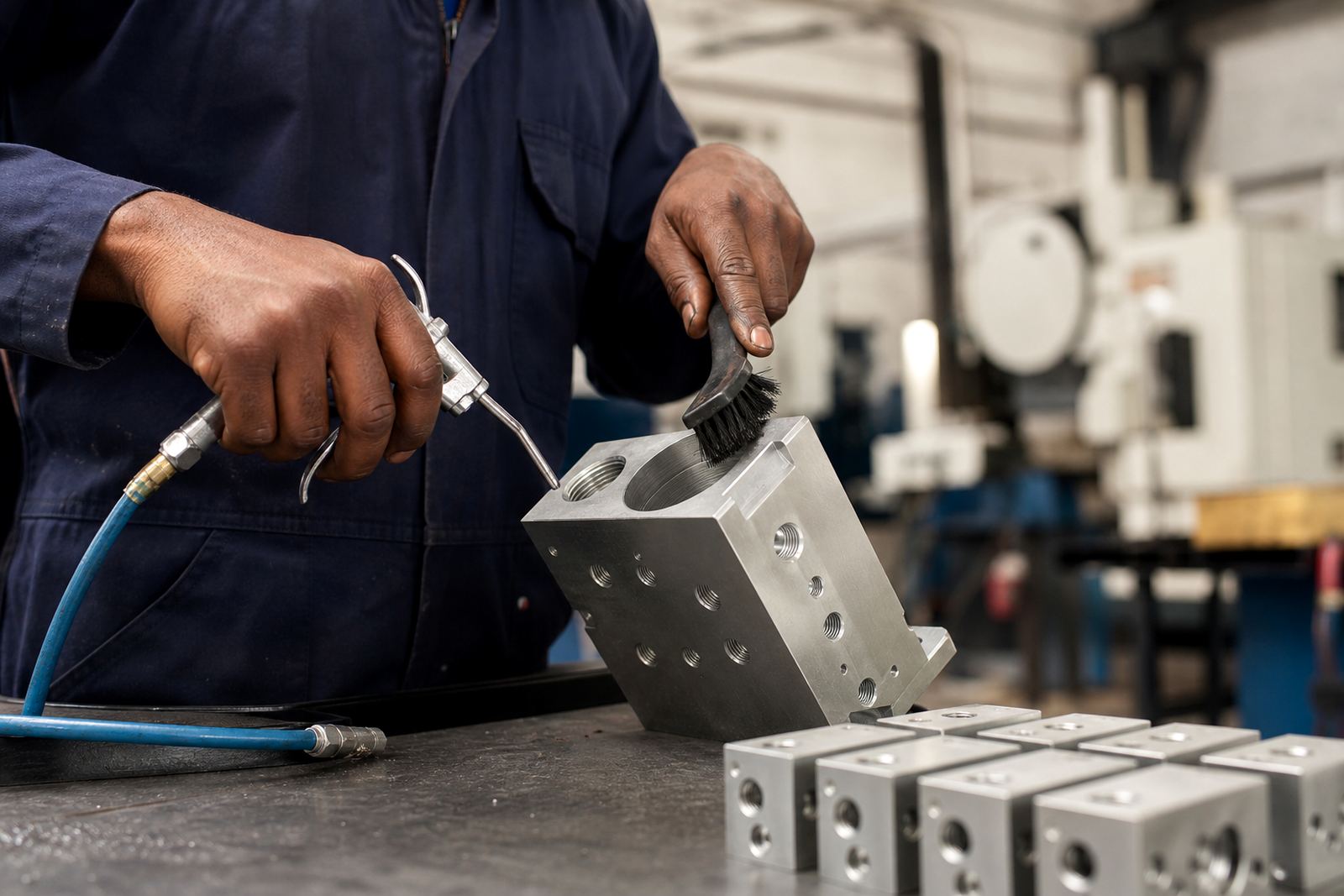
Why tapped holes fail in finished parts
A tapped hole can look fine on the outside and still cause trouble at assembly. Chips left in the thread, a damaged lead-in, poor depth control or the wrong hole size for the tap can all lead to stiff tightening, cross-threading or a fastener that never reaches proper engagement.
In small-batch machining, that matters because parts often move straight from machining to assembly with little spare time for correction. If a bracket, housing or plate is going into a machine build, every hole has to be ready for the job it was cut for.
What clean threads actually do for the assembly crew
Clean threads make a real difference on the floor. A bolt or screw should enter by hand for the first few turns before it is tightened to spec. If the thread is dirty, burred or packed with coolant residue, the installer may apply too much force and strip the hole or the fastener.
- They reduce the risk of cross-threading during assembly.
- They help achieve even clamping load across a joint.
- They make later maintenance easier when the part comes back for service.
- They limit the chance of galling on stainless or other difficult materials.
For components that travel from Pinetown to Durban or Richards Bay, that extra care is useful because vibration, coastal humidity and transport handling can all affect how a part arrives at the final fit-up stage.
Correct thread depth and fastener engagement
Thread depth is not only about getting the tap to the right number of turns. It is about leaving enough full thread for the fastener to carry load without bottoming out. If the hole is too shallow, the bolt may tighten against the end of the hole instead of clamping the component together.
Good fastener engagement means the bolt or screw uses enough of the thread length in the parent material to do its job. The exact requirement depends on the material, the diameter of the fastener and how the part will be loaded. Soft materials usually need more care than harder ones, and thin sections need particular attention so the thread does not pull out under load.
That is why a drawing review and tolerance guidance are useful early in the job, not only at final inspection.
Materials that need extra thread care
Different materials behave differently when tapped. Mild steel usually cuts cleanly when tooling is correct, while aluminium can grab and leave torn threads if chips are not cleared. Stainless steel often needs slower, controlled cutting because it work-hardens if conditions are poor. Brass, cast materials and certain plastics each bring their own thread behaviour too.
For a job shop handling small batches, the process needs to match the material rather than forcing one setting across all parts. That is where material selection and part optimisation help prevent stripped holes, split bosses or inconsistent thread feel from part to part.
- Use the right pilot hole size for the thread form.
- Clear swarf often during tapping and after machining.
- Deburr the entry so the fastener starts cleanly.
- Check that the hole is deep enough for the intended screw length.
On a humid coastal job, surface condition matters too. A tapped hole left with loose chips or moisture can be harder to assemble later, especially if the part sits for a few days before fitment.
Inspection points that catch problems early
Inspection reporting should confirm more than overall dimensions. A tapped hole can meet a drawing size and still cause a problem if the thread is rough, off-angle or partly blocked. A simple check during production saves time later, especially where repeat orders need to match a sample part that already works.
Typical checks include thread form, depth, entry condition and the surrounding face where the fastener head or washer seats. If a part has multiple tapped holes, their position relative to the mating component matters just as much as the thread itself.
- Check hand fit with a suitable fastener before final release.
- Confirm thread depth against the drawing and the actual screw length.
- Look for burrs on the exit side where applicable.
- Verify that the fastener seats square to the face.
A local example from the workshop floor
Picture a small machined cover made in Pinetown for a customer in Johannesburg. The part has a row of tapped holes for repeated opening and closing during maintenance. If one hole is not cleaned properly, the technician on site may force the screw, mark the face, or round out the thread after only a few services.
With the right drawing review, sample part remake if needed, and proper inspection before dispatch, that same cover can go out ready for assembly and stay serviceable. It is a simple part, but the thread detail carries a lot of weight in the final result.
That is why tapped hole care is not just a finishing touch. It is part of making sure the job works where it matters, at the machine, on the site, and during future maintenance.
How PME CNC Machining supports tapped hole quality
At PME CNC Machining in Pinetown, tapped hole work sits inside the broader job process, from prototype planning to repeat order support. The team reviews drawings, checks material choice, plans the batch and confirms the fit before release. If a thread detail needs a drawing update or a practical adjustment, that is handled with the same care as the machining itself.
For clients across Durban, Westmead, New Germany, Pietermaritzburg, Richards Bay, Umhlanga and Johannesburg, the goal is straightforward: parts that assemble properly first time and still make sense when they need to be serviced later. In small-batch work, that can save a lot of back-and-forth and a lot of rework.