

Started in Pinetown, built around real workshop needs
PME CNC Machining was founded in 2008 in Pinetown, KwaZulu-Natal, where production demands are practical and schedules are tight. From the beginning, the focus has been on making small runs of parts that need attention to detail rather than mass production shortcuts. That means listening closely to drawings, checking what the part must do in service, and planning the job so the finished pieces suit the application first time or as close as possible.
Working from Pinetown gives us access to the wider Durban industrial area and good reach into the rest of the country. We regularly support orders for Durban, Westmead, New Germany, Pietermaritzburg, Richards Bay, Umhlanga and Johannesburg, with coordination for delivery where needed. For us, being local means understanding the pressure of late changes, machine downtime and supplier lead times, especially when a job has to keep a production line moving.
How we approach CNC milling and turning
Our work centres on CNC milling and turning for small-batch components. Milling is suited to parts with flats, pockets, slots, holes and shaped faces, while turning is used for round parts such as shafts, bushes, spacers and stepped diameters. Many jobs need both processes, plus secondary operations and careful inspection before release. The aim is not to overcomplicate a part when a simpler route will do, but also not to oversimplify when an extra operation will save problems later.
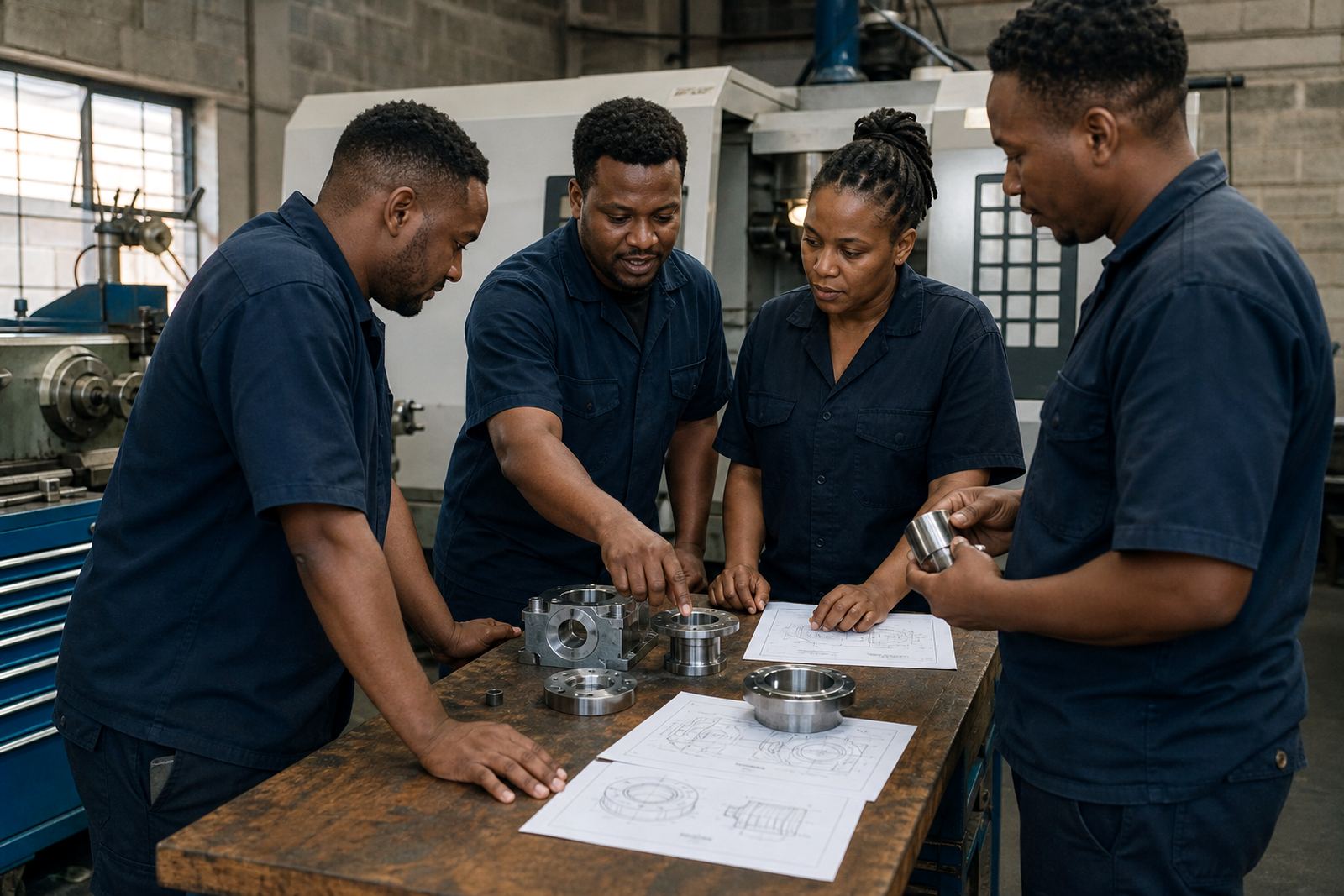
We work from customer drawings, sketches or part samples, then review the geometry and the likely machining sequence. That includes checking dimensions that may affect fit, assembly and wear. If a tolerance looks unusually tight, or if a surface finish or edge condition could influence performance, we discuss it before cutting starts. In small batch work, that conversation can save time, scrap and rework.
- Drawing Review for practical manufacturability checks
- Prototype Planning for first-off parts and sample adjustments
- Batch Planning for repeatable small runs
- Tolerance Guidance where fit or function needs extra care
- Part Optimisation to reduce unnecessary machining
Materials we machine and why selection matters
Small-batch machining often involves a mix of metals and engineering plastics, depending on the job. Common material choices can include mild steel, stainless steel, aluminium, brass, copper and selected polymers. Each material behaves differently during cutting, clamping and finishing, so selection affects accuracy, tool wear, surface quality and cost. Coastal humidity around Durban and Richards Bay can also matter, because corrosion resistance may be a real concern for parts stored outdoors or used near the sea.
We help clients weigh up how the part will be used, not just how it looks on paper. For example, a component for repeated assembly may need a different approach to edge treatment than a one-off bracket. A part exposed to moisture may need a material choice that handles rust better, while a part used in heat or vibration may need better wear resistance. There is no single answer for every job, which is why material advice is part of the service rather than an afterthought.
Where drawings do not specify enough detail, we can assist with selection based on function, machining behaviour and availability. We do not promise every tolerance on every material, because real machining depends on the full job setup, but we do work carefully to keep dimensions within the agreed requirements and to flag issues early if something on the drawing needs attention.
Small-batch work that stays organised
Our shop is set up for repeatable small runs, prototype pieces and replacement parts where accuracy matters. We are often asked to remake a sample part, refine a drawing, or produce a short batch after a trial fit. That kind of work calls for good communication, sensible sequencing and proper records so the next order can be handled consistently. It also means keeping an eye on inspection at key points, not just at the end.
We support jobs from first enquiry through to delivery coordination. When needed, we can compare sample parts against the drawing, check assembly fit, and suggest updates that make future orders easier to produce. We also handle repeat order support, because many clients need the same parts again months later and want the same fit and finish without starting from scratch.
- Sample Part Remake after trial fitting or adjustment
- Assembly Fit Checks before release to production
- Inspection Reporting for critical dimensions and notes
- Repeat Order Support for consistent later runs
- Drawing Updates when practical changes are agreed
The people behind the machining
PME CNC Machining is led by Mandla Sibusiso Mkhize, with a team built around production control, programming, supervision, quality and client communication. That structure helps small jobs move without confusion. When a drawing comes in, it does not just sit in a queue. It is reviewed, planned and assigned with the next steps in mind. That matters when a client is waiting on one critical component or a small batch to keep work moving.
The team includes Anele Nondumiso Dlamini in Production Coordination, Johan Petrus van Wyk as Lead CNC Programmer, Siyabonga Patrick Zulu as Machining Supervisor, Naledi Refilwe Molefe handling Quality Administration, and Kyle Brendan Naidoo supporting clients through the enquiry and job flow. Each person plays a part in making sure the work is understood before the machine starts cutting. Good machining is not only about the cut itself, it also depends on the planning around it. Small details matter, sometimes more than people expect.
That approach suits the type of work we do for businesses across Durban, Pinetown, Pietermaritzburg, Richards Bay and Johannesburg. Some clients need one off parts, others need repeat batches, and some simply need a practical view on whether a drawing can be made as intended. We try to answer clearly and keep the process moving without drama.
Why clients come back to us
Clients usually want three things from a machining supplier: parts that match the drawing, communication they can trust, and delivery that fits the job schedule. We aim to cover all three. That includes being clear about what can be made, what needs checking and where a design may benefit from a small change. We do not oversell the job. If something needs more time, more information, or a different approach, we say so early.
Many of our enquiries come through the contact page enquiry form, which helps keep the job information in one place and avoids confusion. From there we can review the drawing, discuss the required quantity and confirm the next steps. For clients in industrial areas like Westmead, New Germany and around the Durban basin, that direct process keeps things practical and saves back-and-forth.
Our values are simple: accuracy, honesty, careful work and respect for deadlines. If the part can be improved for fit or manufacturability, we will point it out. If the drawing is already sound, we will machine to it with the same level of care. That is how we have worked since 2008, and it is still the standard we hold to today.
How to start a job with PME CNC Machining
If you need CNC milling, CNC turning, or a small-batch remake, the best place to start is with the drawing or sample part. From there we can assess the job, discuss material options and identify any points that may affect machining or fit. When the brief is clear, the rest tends to run much smoother, whether the order is for Pinetown, Umhlanga, Richards Bay or further afield.
We are set up for parts that need sensible attention, not guesswork. That applies to prototype planning, batch planning, drawing review and tolerance guidance alike. If a job needs careful handling, we would rather take the time to get it right than rush it and create problems later. That plain approach has served us well for years, and it is what clients tend to remember.